
St. Tropez, [France,] July 12th, 1936 It is only two weeks since our beloved comrade Alexander Berkman passed away. Yet it seems an eternity to me. The blow his untimely death has struck me has left me completely shattered. I find it difficult to collect my thoughts. But I feel sure you will want to know all about Sasha's end. For have you not loved him all through the years? Sasha left a note which we found after we returned from his last resting place. It reads: "I don't want to live a sick man. Dependent. Forgive me Emmie darling. And you too Emma. Love to All. Help Emmie." signed, Sasha. I have two letters from comrade Berkman dated June 24th and 26th. He wrote while he did not feel strong enough to come to St. Tropez the 27th, my sixty... (From : Anarchy Archives.)

The ResurrectionOn the following day the brilliant and jovial Shenbok called at the aunts for Nekhludoff, and completely charmed them with his elegance, amiability, cheerfulness, liberality, and his love for Dmitri. Though his liberality pleased the aunts, they were somewhat perplexed by the excess to which he carried it. He gave a ruble to a blind beggar; the servants received as tips fifteen rubles, and when Sophia Ivanovna's lap-dog, Suzette, hurt her leg so that it bled, he volunteered to bandage it, and without a moment's consideration tore his fine linen handkerchief (Sophia Ivanovna knew that those handkerchiefs were worth fifteen rubles a dozen) and made bandages of it for the dog. The aunts had never seen such men, nor did they know that his debts ran up to two hundred thousand rubles, which—he knew—would never be paid, and that therefore twenty-five rubles more or less made no appreciable difference in his accounts. Shenbok remained but one day, and t...

Why do you clothe me with scarlet of shame? Why do you point with your finger of scorn? What is the crime that you hissingly name When you sneer in my ears, "Thou bastard born?" Am I not as the rest of you, With a hope to reach, and a dream to live? With a soul to suffer, a heart to know The pangs that the thrusts of the heartless give?" I am no monster! Look at me -- Straight in my eyes, that they do not shrink! Is there aught in them you can see To merit this hemlock you make me drink? This poison that scorches my soul like fire, That burns and burns until love is dry, And I shrivel with hate, as hot as a pyre, A corpse, while its smoke curls up to the sky? Will you touch my hand? It is flesh like yours; Perhaps a little more brown and gr... (From : Anarchy Archives.)
Boyhood, by Leo Tolstoy
Translated by C.J. HOGARTH CONTENTS I. A SLOW JOURNEY II. THE THUNDERSTORM III. A NEW POINT OF VIEW IV. IN MOSCOW V. MY ELDER BROTHER VI. MASHA VII. SMALL SHOT VIII. KARL IVANITCH’S HISTORY IX. CONTINUATION OF KARL’S NARRATIVE X. CONCLUSION OF KARL’S NARRATIVE XI. ONE MARK ONLY XII. THE KEY XIII. THE TRAITRESS XIV. THE RETRIBUTION XV... (From : Gutenberg.org.)

Childhood, by Leo Tolstoy
Translated by C.J. Hogarth CONTENTS I THE TUTOR, KARL IVANITCH II MAMA III PAPA IV LESSONS V THE IDIOT VI PREPARATIONS FOR THE CHASE VII THE HUNT VIII WE PLAY GAMES IX A FIRST ESSAY IN LOVE X THE SORT OF MAN MY FATHER WAS XI IN THE DRAWING-ROOM AND THE STUDY XII GRISHA XIII NATALIA SAVISHNA XIV THE PARTING XV &n... (From : Gutenberg.org.)

A Tale of 1852It was quite dark when Uncle Eroshka and the three Cossacks, in their cloaks and shouldering their guns, left the cordon and went towards the place on the Terek where they were to lie in ambush. Nazarka did not want to go at all, but Lukashka shouted at him and they soon started. After they had gone a few steps in silence the Cossacks turned aside from the ditch and went along a path almost hidden by reeds till they reached the river. On its bank lay a thick black log cast up by the water. The reeds around it had been recently beaten down. 'Shall we lie here?' asked Nazarka. 'Why not?' answered Lukashka. 'Sit down here and I'll be back in a minute. I'll only show Daddy where to go.' 'This is the best place; here we can see and not be seen,' said Ergushov, 'so it's here we'll lie. It's a first-rate place!' Nazarka and Ergushov spread out their cloaks and settled down behind the log, while Lukashka went on with Uncle Eroshka. 'It's no...

A Tale
p>--NEQUE SEMPER ARCUM TENDIT APOLLO. HOR. LONDON: PRINTED FOR T. HOOKHAM, AT HIS CIRCULATING LIBRARY, NEW BOND-STREET, CORNER OF BRUTON-STREET. M,DCC,LXXXIV. CONTENTS PART the FIRST. CHAPTER I. Containing introductory Matter. CHAPTER II. A Ball CHAPTER III. A Ghost. CHAPTER IV. A love Scene. CHAPTER V. A Man of Humor. CHAPTER VI. Containing some Specimens of Heroism. CHAPTER VII. Containing that with which the Reader will be acquainted when he has read it. CHAPTER VIII. Two Persons of Fashion. CHAPTER IX. A tragical Resolution. CONTENTS. PART the SECOND. CHAPTER I. In which th... (From : Gutenberg.org.)

On everything that lives, if one looks searchingly, is limned the shadow line of an idea --- an idea, dead or living, sometimes stronger when dead, with rigid, unswerving lines that mark the living embodiment with the stern immobile cast of the non-living. Daily we move among these unyielding shadows, less pierceable, more enduring than granite, with the blackness of ages in them, dominating living, changing bodies, with dead, unchanging souls. And we meet, also, living souls dominating dying bodies-living ideas regnant over decay and death. Do not imagine that I speak of human life alone. The stamp of persistent or of shifting Will is visible in the grass-blade rooted in its clod of earth, as in the gossamer web of being that floats and sw... (From : Anarchy Archives.)

Translated by Robert Helms "Des ilections" first appeared in La France (Paris), Aug.12, 1885. What's going to happen? Where will we flee? Already the election campaigns are infected by a terrible leprosy. The cabarets roar, rolling over with drunken eyes. Looming above the intersections, the red, blue, and yellow posters explode across the walls of solitary houses. The peasants hurry to gather their wheat and oats before the political whirlwind blows in, like a devastating sirocco. The bad smell of spilled wine is hanging in the air, and the deafening clamor of committees comes from everywhere, left, right, and center, calling for an encore, and marking time on the bass drum of alcoholic frenzy. People walk by, cross themselves, don't recog... (From : Mid-Atlantic Infoshop.)

In Petersburg in the eighteen-forties a surprising event occurred. An officer of the Cuirassier Life Guards, a handsome prince who everyone predicted would become aide-de-camp to the Emperor Nicholas I. and have a brilliant career, left the service, broke off his engagement to a beautiful maid of honor, a favorite of the Empress’s, gave his small estate to his sister, and retired to a monastery to become a monk. This event appeared extraordinary and inexplicable to those who did not know his inner motives, but for Prince Stepan Kasatsky himself it all occurred so naturally that he could not imagine how he could have acted otherwise. His father, a retired colonel of the Guards, had died when Stepan was twelve, and sorry as his mother was to part from her son, she entered him at the Military College as her deceased husband had intended. The widow herself, with her daughter, Varvara, moved to Petersburg to be near her son and have him with her for the ho...

FLEETWOOD; or, THE NEW MAN OF FEELING. by WILLIAM GODWIN. CHAPTER II The proper topic of the narrative I am writing is the record of my errors, To write it, is the act of my pentinence and humiliation. I can expect however few persons to interest themselves respecting my errors, unless they are first informed what manner of man I am, what were my spontaneous and native dispositions, and whether I am such a one as that my errors are worthy of commiseration and pity. This must be my apology for the topic I am here to introduce, a topic on which all ingenous minds are disposed to be silent, and which shall in this place be passed over as flightly as possible, my beneficence and charities. I was fond of penetrating into the cottages of the poor. I should be greatly unjust to myself, if I suffered the reader to suppose that the wild elevati...

Mr. Mencken gives the impression of an able mind so harried and irritated by the philistinism of American life that it has not been able to attain its full power. These more carefully worked-over critical essays are, on the whole, less interesting and provocative than the irresponsible comment he gives us in his magazine. How is it that so robust a hater of uplift and puritanism becomes so fanatical a crusader himself? One is forced to call Mr. Mencken a moralist, for with him appraisement has constantly to stop while he tilts against philistine critics and outrageous puritans. In order to show how good a writer is, he must first show how deplorably fatuous, malicious or ignorant are all those who dislike him. Such a proof is undoubtedly th... (From : fair-use.org.)

The Russian Language--Early folk literature: Folklore-- Songs-Sagas-Lay of Igor's Raid-Annals-The Mongol Invasion; its consequences-Correspondence between John IV. and Kúrbiskíy-Split in the Church-Avvakúm's Memoirs- The eighteenth century: Peter I. and his contemporaries-Tretiakóvsky-Lomonósoff-Sumarókoff-The times of Catherine II.-Derzhávin-Von Wízin-The Freemasons: Novikóff; Radíscheff-Early nineteenth century: Karamzín and Zhukóvskiy-The Decembrists-Ryléeff. One of the last messages which Turguéneff addressed to Russian writers from his death-bed was to implore them to keep in its purity "that precious inheritance of ours.-the Russian Language." He who knew in perfection most...
From: William Godwin . Imogen: A Pastoral Romance From the Ancient British. BOOK THE FIRST CHARACTER OF THE SHEPHERDESS AND HER LOVER. -FEAST OF RUTHYN.-SONGS OF THE BARDS. LISTEN, O man! to the voice of wisdom. The world thou inhabitest was not intended for a theater of fruition, nor destined for a scene of repose. False and treacherous is that happiness, which has been preceded by no trial, and is connected with no desert. It is like the gilded poison that undermines the human frame. It is like the hoarse murmur of the winds that announces the brewing tempest. Virtue, for such is the decree of the Most High, is evermore obliged to pass through the ordeal of temptation, and the thorny paths of adversity. If, in this day of her trial, no foul blot obscure her luster, no irresolution and instability tarnish the clearness of her spirit, then may she rejoice in the view of her approaching reward, and receive with an open heart the...

Jefferson City, MO, 29 June 1919, Darling, mine. There is so much, so much I want to write you. I scarcely know where to begin & where to let off. I will have to content myselfs with the most essential & leave the other when we meet - just three months from to day. My birth-day - like last year I spent it in bed. Not quite so ill, but in pain & discomfiture. The same thing I had 2 weeks ago & which I will probably have to endure during most of the Summer. As a result of my laying off a very funny thing happened. Funny only because I have so short a time in here. Other wise it would have been the beginning of a serious & bitter struggle. I have repeatedly written you how very decent Dr Mc Nearney has always been to me. As... (From : University of Berkeley.)

Selected Letters of Nicola Sacco from the Dedham Jail November 30, 1921. Dedham Jail DEAR BARTOLO: Saturday the 26th my Rosie and the children came to visit me, and this was the first time I seen the children since the time you left Dedham. You can imagine how happy I felt to see them so joyful and so gay and in the best of health, if only you could see little Ines. She got so fat, she is really a dolly, Dante also looks very good. He writes to me every week. Rosa also looks very good after the operation she is gaining daily. I feel very good and I don't do nothing but exercise, read and write. I am very sorry that no one comes and see you, no one comes to see me neither, but Rosie . . . [Rosie and Rosa refer to Sacco’s wife Rosina. I... (From : umkc.edu.)

Ricardo Flores Magon Post Office Box 7 Leavenworth, Kansas March 16, 1922 Miss Erma Barsky New York, N.Y. My dear comrade: Your postcard, and a letter from Dr. Weinberger received. Mr. Weinberger most kindly makes me know how my case, for lack of proper recommendations, cannot go to the President to be considered, according to word sent him by the Department of Justice. The recommendations, strange as it would seem to common mortals, are not my growing infirmity, nor the flagrant violation of the most rudimentary justice committed by the judge of my trial, nor my having dependents, nothing, in fine, that might appeal to the average human heart and conscience. The recommendations which the government officials deem of great importance are th... (From : Anarchy Archives.)

Naked Warriors Herbert Read, London: Art & Letters, 1919. PREFACE I would like to speak for a generation to following effect: We, who in manhood's dawn have been compelled to care not a damn for life or death, now care less still for the convention of glory and the intellectual apologies for what can never be to us other than a riot of ghastliness and horror, of inhumanity and negation. May we, therefore, for the sake of life itself, be resolved to live with a cleaner and more direct realization of natural values. May we be unafraid of our frank emotions, and may we maintain a callous indifference to falsely-artistic prettifying of life. Then, as the reflex of such beauty where hitherto it has had no absolute existence. From sickness of... (From : Anarchy Archives.)

A exhibition of pictures is now taking place in Paris which is of interest to all those whose feeling is one with the masses of the people. Some Socialists are inclined to look for little sympathy from painters. Some even have tried to set fire to picture galleries, saying like the earlier Nihilists of Russia, that a cobbler, who makes what is useful, is greater than Raphael, who only made what is beautiful. and that when men and women are dying of slow starvation before our eyes, it is idle to think of mixing a pot of color. Is this not a mistake? Are not painters as much with us as poets, writers, and even shoemakers? To take Jean François-Millet as an example. Born a laborer, he learned to draw in Paris, and then took a cottage so... (From : AnarchyArchives.)
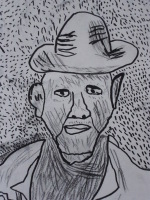
Almost stumbling against the prince, the young wife precipitately set down the tub, showed a little embarrassment, dropped a courtesy, and then with shining eyes glanced up at him, and, endeavoring to hide a slight smile behind the sleeve of her embroidered shirt, ran up the steps, clattering in her wooden shoes. "Mother, you take the water-yoke to aunt Nastásia," said she, pausing at the door, and addressing the old woman. The modest young proprietor looked sternly but scrutinizingly at the rosy woman, frowned, and turned to the old dame, who, seizing the yoke with her crooked fingers, submissively lifted it to her shoulder, and was about to direct her steps to the adjacent hut. "Your son at home?" asked the prince. The old woman, her bent form bent more than usual, made an obeisance, and tried to say something in reply, but, suddenly putting her hand to her mouth, was taken with such a fit of coughing, that Nekhliudof with...

Night in a prison cell! A chair, a bed, a small washstand, four blank walls, ghastly in the dim light from the corridor without, a narrow window, barred and sunken in the stone, a grated door! Beyond its hideous iron latticework, within the ghastly walls, -a man! An old man, gray-haired and wrinkled, lame and suffering. There he sits, in his great loneliness, shut in front all the earth. There he walks, to and fro, within his measured space, apart from all he loves! 'There, for every night in five long years to come, he will walk alone, while the white age-flakes drop upon his head, while the last years of the winter of life gather and pass, and his body draws near the ashes. Every night, for five long years to come, he will sit alone, this... (From : Anarchy Archives.)

THE GERMAN DRAMA: GERHART HAUPTMANN LONELY LIVES Gerhart Hauptmann is the dramatist of whom it may be justly said that he revolutionized the spirit of dramatic art in Germany: the last Mohican of a group of four-Ibsen, Strindberg, Tolstoy, and Hauptmann-who illumined the horizon of the nineteenth century. Of these Hauptmann, undoubtedly the most human, is also the most universal. It is unnecessary to make comparisons between great artists: life is sufficiently complex to give each his place in the great scheme of things. If, then, I consider Hauptmann more human, it is because of his deep kinship with every stratum of life. While Ibsen deals exclusively with one attitude, Hauptmann embraces all, understands all, and portrays all, because nothing human is alien to him. Whether it be the struggle of the transition stage in " Lonely Lives," or the conflict between the Ideal and the Real in " The Sunken Bell," or the brutal background of poverty in...

Last summer I received from the Toronto organizing committee the invitation to come out to Canada with the British Association. It is well known, but it gives me great pleasure to acknowledge it once more that the members of the British Association, whether British or foreign, received from the Canadians -- and those of us who went to the States from the Americans -- the most friendly welcome, and were treated with the utmost cordiality and hospitality. Many a standing friendship between scientific men of the Old and the New World has grown up during that visit. After the meeting of the British Association was over a most instructive trip was organized by the Canadian Pacific Railway Association across the continent to Vancouver, and I had ... (From : Anarchy Archives.)

I begin with an admission: Regardless of all political and economic theories, treating of the fundamental differences between various groups within the human race, regardless of class and race distinctions, regardless of all artificial boundary lines between woman's rights and man's rights, I hold that there is a point where these differentiations may meet and grow into one perfect whole. With this I do not mean to propose a peace treaty. The general social antagonism which has taken hold of our entire public life today, brought about through the force of opposing and contradictory interests, will crumble to pieces when the reorganization of our social life, based upon the principles of economic justice, shall have become a reality. Peace o... (From : Anarchy Archives.)

[The two Camps, which is here included, was translated by "Crastinus" from Bakunin's preface to his pamphlet refuting Mazini's theisic idealism. This work was published in the year 1871. At this time Italy witnessed the breaking-up of the workers' associations, guided by the patriotic spirit, and saw the spreading of the ideals of International Socialism, as well as the conflict between the capitalist and the working class conceptions of life. After nearly fifty years, the vibrating audacity of Bakunin's thought, their penetrating inwardness, their generosity are as alive as ever. ---ED.] You taunt us with disbelieving in God. We charge you with believing in him. We do not condemn you for this. We do not even indict you. We pity you. For th... (From : Anarchy Archives.)

Translated from the French by Robert Helms "Le Mur" first appeared in L'Echo de Paris on February 20, 1894 Old man Rivoli had a wall. This wall ran along a road, and it was crumbling badly. The rains and the road mender's pickax had undermined the base. The stones, having come loose, hardly held together any longer, and cracks were opening up. It was beautiful, however, having the look of an ancient ruin. Some irises crowned the top, while figworts, maidenhair, and houseleeks pushed their way through the fissures. Some poppies, too, paraded their frail bodies between cracks in the rubble-stones. But Pop Rivoli was not sensitive to the poetry of his wall, and, after examining it at length, and jiggling some of its loose stones like teeth in ... (From : Mid-Atlantic Infoshop.)

"WORK WHILE IT IS DAY; THE NIGHT COMETH WHEN NO MAN CAN WORK." The time was Spring and the man's heart was glad within him at the thought of his garden and of the flowers which he would plant there and the seeds be would sown. And he rose in the morning and the sun laughed through the fleecy clouds and soft showers that kissed the breast of the fruitful earth. In the orchard among the blossomed fruit trees the birds were making love. The whole world laughed to sea itself so beautiful. A morning of sunlight and soft airs and hope and promise. Who could work on such a morning? So the man said: "I will walk with my beloved between the green hedges and gather the primroses and violets, and I can think and talk about where the roses and lilies s... (From : AnarchyArchives.)

Youth, by Leo Tolstoy
All went well until my examination in Latin. So far, a gymnasium student stood first on the list, Semenoff second, and myself third. On the strength of it I had begun to swagger a little, and to think that, for all my youth, I was not to be despised. From the first day of the examinations, I had heard every one speak with awe of the Professor of Latin, who appeared to be some sort of a wild beast who battened on the financial ruin of young men (of those, that is to say, who paid their own fees) and spoke only in the Greek and Latin tongues. However, St. Jerome, who had coached me in Latin, spoke encouragingly, and I myself thought that, since I could translate Cicero and certain parts of Horace without the aid of a lexicon, I should do no worse than the rest. Yet things proved otherwise. All the morning the air had been full of rumors concerning the tribulations of candidates who had gone up before me: rumors of how one young fellow had been accorded a naught, another one...