
A French writer, sympathetic to anarchism, wrote in the 1890s that "anarchism has a broad back, like paper it endures anything"---including, he noted those whose acts are such that "a mortal enemy of anarchism could not have done better." There have been many styles of thought and action that have been referred to as "anarchist." It would be hopeless to try to encompass all of these conflicting tendencies in some general theory or ideology. And even if we proceed to extract from the history of libertarian thought a living, evolving tradition, as Daniel Guérin does in Anarchism, it remains difficult to formulate its doctrines as a specific and determinate theory of society and social change. The anarchist historian Rudolph Rocker, who presents a systematic conception of the development of anarchist thought towards anarchosyndicalism, along lines that bear comparison to Guérins work, puts the matter well when he writes that anarchism is not a fixed, self-enc...
From my copy of Alexander Berkman's The Kronstadt Rebellion, Berlin: Der Sindikalist, 1922. Russian Revolution Series The Kronstadt Rebellion By Alexander Berkman Fifteen Cents 1922 I. LABOR DISTURBANCES IN PETROGRAD It was early in 1921. Long years of war, revolution, and civil struggle had bled Russia to exhaustion and brought her people to the brink of despair. But at last civil war was at an end: the numerous fronts were liquidated, and Wrangel -- the last hope of Entente intervention and Russian counter-revolution -- was defeated and his military activities within Russia terminated. The people now confidently looked forward to the mitigation of the severe Bolshevik régime. It was expected that with the end of civil war the Commu... (From : Anarchy Archives.)

CHAPTER II PETROGRAD MY PARENTS had moved to St. Petersburg when I was thirteen. Under the discipline of a German school in Königsberg and the Prussian attitude toward everything Russian, I had grown up in the atmosphere of hatred to that country. I dreaded especially the terrible Nihilists who had killed Czar Alexander II, so good and kind, as I had been taught. St. Petersburg was to me an evil thing. But the gaiety of the city, its vivacity and brilliancy, soon dispelled my childish fancies and made the city appear like a fairy dream. Then my curiosity was aroused by the revolutionary mystery which seemed to hang over everyone, and of which no one dared to speak. When four years later I left with my sister for America I was no longer the German Gretchen to whom Russia spelt evil. My whole soul had been transformed and the seed planted for what was to be my life's work. Especially did St. Petersburg remain in my memory a vivid picture,...

MY FURTHER DISILLUSIONMENT IN RUSSIA By Emma Goldman, Garden City, NY: Doubleday, Page & Company; 1924 CHAPTER I ODESSA AT THE numerous stations between Kiev and Odessa we frequently had to wait for days before we managed to make connections with trains going south. We employed our leisure in visiting the small towns and villages, and formed many acquaintances. The markets were especially of interest to us. In the Kiev province by far the greater part of the population is Jewish. They had suffered many pogroms and were now living in constant terror of their repetition. But the will to live is indestructible, particularly in the Jew; otherwise centuries of persecution and slaughter would long since have destroyed the race. Its peculiar perseverance was manifest everywhere: the Jews continued to trade as if nothing had happened. The news that Americans were in town would quickly gather about us crowds of people anxi...
PREFACE Clarity of ideas is not characteristic of the average mind. Many people still continue to think and to talk of the Russian Revolution and of the Bolsheviki as if the two were identical. In other words, as if nothing had happened in Russia during the last three years. The great need of the present is to make clear the difference between that grand social event and the ruling, political party --- a difference as fundamental as it has been fatal to the Revolution. The following pages present a clear and historically true picture of the ideals that inspired the Revolution, and of the role played by the Bolsheviki. This pamphlet conclusively proves what the Russian Revolution IS and what the BoIshevik State, alias the Communist Party, IS... (From : Anarchy Archives.)
The Russian Revolution Series No.1 The RUSSIAN TRAGEDY (A Review and An Outlook) by Alexander Berkman FOREWORD We live at a time when two civilizations are struggling for their existence. Present society is at death grips with the New Ideal. The Russian Revolution was but the first serious combat of the two forces, whose struggle must continue till the final triumph of the one or of the other. The Russian Revolution has failed - failed of its ultimate purpose. But that failure is a temporary one. In the point of revolutionizing the thought and feeling of the masses of Russia and of the world, in undermining the fundamental concepts of existing society, and lighting the torch of faith and hope for the Better Day, the Russian Revolution has b... (From : Anarchy Archives.)
"Discussing the activities and role of the Anarchists in the Revolution, Kropotkin said: 'We Anarchists have talked much of revolutions, but few of us have been prepared for the actual work ,to be done during, the process. I have indicated some things in this relation in my Conquest of Bread. Pouget and Pataud have also sketched a line of action in their work on Syndicalism and the Cooperative Commonwealth. Kropotkin thought that the Anarchists had not given sufficient to the fundamental elements of the social revolution. The real facts in a revolutionary process do not consist so much in actual fighting--that is, merely the destructive phase necessary to clear the way for constructive effort. The basic factor in a revolution is the organiz... (From : Anarchy Archives.)
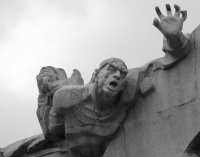
It is only a few months now to the tenth anniversary of the October Revolution. Great preparations are being made by the Communist Party and Government of Russia for the celebration of the important event. Numerous committees are at work to make the day the most memorable in the annals of Soviet Russia, and to demonstrate to the country and to the world at large the achievements of the first decade of Bolshevik rule. There is no doubt that the October Revolution was the most significant social upheaval known in human history. It broke all the molds of established society - not merely political forms, as was the case in previous revolutions, but the very economic foundations that support human slavery and oppression. The spiritual achievemen... (From : Anarchy Archives.)
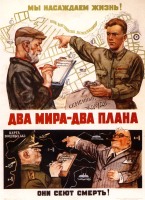
The victorious revolution of the workers and peasants in 1917 was legally established in the Bolshevik calendar as the October Revolution. There is sane truth in this, but it is not entirely exact. In October 1917 the workers and peasants of Russia surmounted a colossal obstacle to the development of their Revolution. They abolished the nominal power of the capitalist class, but even before that they achieved something of equal revolutionary importance and perhaps even more fundamental. By taking the economic power from the capitalist class, and the land from the large owners in the countryside, they achieved the right to free and uncontrolled work in the towns, if not the total control of the factories. Consequently, it was well before Oct... (From : Flag.Blackened.net.)

Part I: Two Conceptions of the Revolution Chapter 1. Two Opposing Conceptions of Social Revolution Our principal task herein is to examine and establish, to the extent of our ability, what is unknown or little known about the Russian Revolution. We begin by emphasizing a fact which, without being ignored, is considered only superficially in the western world. This: In October, 1917, this revolution entered upon wholly new terrain — that of the great Social Revolution. Thus it advanced on a very special route which was totally unexplored. It follows that the subsequent development of the Revolution assumed an equally new and original character. Therefore, our account will not resemble any of the existing histories of that revolt. Its general appearance, the factors it comprised, its very language, will change, taking on an unaccustomed and singular aspect. We go on to another fact which is less well known, and which for...

Now and After: The ABC of Communist AnarchismBut take a closer look at it and see how the system 'works'. Consider how life and its real meaning have become turned upside down and topsy-turvy. See how your own existence is poisoned and made miserable by the crazy arrangement. Wherein is the purpose of your life, where the joy of it? The earth is rich and beautiful, the bright sunshine should gladden your heart. Man's genius and labor have conquered the forces of nature and harnessed the lightning and the air to the service of humanity. Science and invention, human industry and toil have produced untold wealth. We've bridged the shoreless seas, the steam engine has annihilated distance, the electric spark and gasoline motor have unfettered man from the earth and chained even the atmosphere to do his bidding. We have triumphed over space, and the farthest corners of the globe have been brought close together. The human voice now circles the hemispheres, and through the azure there dart-fleet messengers,...