
Anarchism means man living free and working constructively. It means the destruction of everything that is directed against man's natural, healthy aspirations. Anarchism is not exclusively a theoretical teaching emanating from programs artificially conceived with an eye to the regulation of life: it is a teaching derived from life across all its wholesome manifestations, skipping over all artificial criteria. The social and political visage of anarchism is a free, anti-authoritarian society, one that enshrines freedom, equality and solidarity between all its members. In anarchism, Right means the responsibility of the individual, the sort of responsibility that brings with it an authentic guarantee of freedom and social justice for each and... (From : NestorMakhno.info.)

Opposition to institutions, support the workers rights because a right without opportunity is no right at all, and our struggle against the exploiters should be led by love and not hatred. (From : HoldOffHunger.)
• "If the proletariat gave and gives so many heroes and martyrs of the cause of human redemption, it also gives off the white guards, the slaughterers, the traitors of their own brothers, without which the bourgeois tyranny could not last a single day."
• "...I had always sought to demonstrate that the social wrongs do not depend on the wickedness of one master or the other, one governor or the other, but rather on masters and governments as institutions; therefore, the remedy does not lie in changing the individual rulers, instead it is necessary to demolish the principle itself by which men dominate over men..."
• "...it is easy to understand the hatred of so many wretches whose bodies and sentiments are tormented and rent by society: however, as soon as the hell in which they live is lit up by an ideal, hatred disappears and a burning desire of fighting for the good of all takes over."

Address to the International Working Men's Association Congress by Emma Goldman Life imposes strange situations on all of us. For forty-eight years I was considered an extremist in our ranks. One who refused to compromise our ideas or tactics for any purpose whatsoever--one who always insisted that the Anarchist aim and methods must harmonize, or the aim would never be achieved. Yet here I am trying to explain the action of our Spanish comrades to the European opponents, and the criticism of the latter to the comrades of the CNT-FAI. In other words, after a lifetime of an extreme left position I find myself in the center, as it were. I have seen from the moment of my first arrival in Spain in September 1936 that our comrades in Spain are pl... (From : Anarchy Archives.)

Freedom: March 1893, p14 Advice to Those About to Emigrate In these days when Home Colonization is seriously discussed, and is even tried, in England as an outlet for the populations of our congested towns, the following letters will be of much interest to our readers. A comrade in New South Wales, writing to Kropotkin for suggestions and advice, says: "As you are probably aware, the Labor movement in Australia has advanced tremendously during the last four or five years. The reason, I believe, lies in the increased agitation in the minds of the people through the late strikes here and also in England and America. The Labor Party here got the worst of it in the last three big strikes, yet the importance of those strikes as factors in educat... (From : Anarchy Archives.)

A French writer, sympathetic to anarchism, wrote in the 1890s that "anarchism has a broad back, like paper it endures anything"---including, he noted those whose acts are such that "a mortal enemy of anarchism could not have done better." There have been many styles of thought and action that have been referred to as "anarchist." It would be hopeless to try to encompass all of these conflicting tendencies in some general theory or ideology. And even if we proceed to extract from the history of libertarian thought a living, evolving tradition, as Daniel Guérin does in Anarchism, it remains difficult to formulate its doctrines as a specific and determinate theory of society and social change. The anarchist historian Rudolph Rocker, who presents a systematic conception of the development of anarchist thought towards anarchosyndicalism, along lines that bear comparison to Guérins work, puts the matter well when he writes that anarchism is not a fixed, self-enc...

ANARCHISM: Its Philosophy and ldeal. Translated from the German by Harry Lyman Koopman. Ever reviled, accursed,-n'er understood, Thou art the grisly terror of our age. "Wreck of all order," cry the multitude, "Art thou, and war and murder's endless rage." O, let them cry. To them that ne'er have striven, The truth that lies behind a word to find, To them the word's right meaning was not given. They shall continue blind among the blind. But thou, O word, so clear, so strong, so pure, That sayest all which I for goal have taken. I give thee to the future! -Thine secure When each at last unto himself shall waken. Comes it in sunshine? In the tempest's thrill? I cannot tell......but it the earth shall see! I am an Anarchist! Wherefore I will No... (From : Anarchy Archives.)

ANARCHISM: WHAT IT REALLY STANDS FOR ANARCHY. Ever reviled, accursed, ne'er understood, Thou art the grisly terror of our age. "Wreck of all order," cry the multitude, "Art thou, and war and murder's endless rage." O, let them cry. To them that ne'er have striven The truth that lies behind a word to find, To them the word's right meaning was not given. They shall continue blind among the blind. But thou, O word, so clear, so strong, so pure, Thou sayest all which I for goal have taken. I give thee to the future! Thine secure When each at least unto himself shall waken. Comes it in sunshine? In the tempest's thrill? I cannot tell--but it the earth shall see! I am an Anarchist! Wherefore I will Not rule, and also ruled I will not be! &... (From : Anarchy Archives.)

The anarchist effort, like any effort, is one focused on social organization, these organizations should be voluntary and cooperative, and it is through these groups that we will establish a better world. (From : HoldOffHunger.)
• "...we anarchists do not want to emancipate the people; we want the people to emancipate themselves. We do not believe in the good that comes from above and imposed by force; we want the new way of life to emerge from the body of the people and correspond to the state of their development and advance as they advance. It matters to us therefore that all interests and opinions should find their expression in a conscious organization and should influence communal life in proportion to their importance."
• "Workers will never be able to emancipate themselves so long as they do not find in union the moral, economic and physical strength that is needed to subdue the organized might of the oppressors."
• "...the agelong oppression of the masses by a small privileged group has always been the result of the inability of the oppressed to agree among themselves to organize with others for production, for enjoyment and for the possible needs of defense against whoever might wish to exploit and oppress them. Anarchism exists to remedy this state of affairs..."

Anarchism versus Socialism By WM. C. Owen. London: Freedom Press, 1922. A FOREWORD "Anarchy versus Socialism," which FREEDOM now reissues, after it has run through its columns (1921-22), was published first some eighteen years ago. Emma Goldman was then one of the most popular lecturers in the United States, and, being questioned constantly as to the difference between the Anarchist and Socialist philosophies, felt the need of a treatise that would explain that difference. At her suggestion I undertook the task. The title showed my conviction that between these two philosophies of life no honest alliance is possible. I considered then that both sides suffered seriously from tile persistent efforts made to reconcile the incompatible, for tho... (From : Anarchy Archives.)

From the Encyclopedia Britannica
ANARCHISM (from the Gr. ἄν, and αρχος, contrary to authority), the name given to a principle or theory of life and conduct under which society is conceived without government - harmony in such a society being obtained, not by submission to law, or by obedience to any authority, but by free agreements concluded between the various groups, territorial and professional, freely constituted for the sake of production and consumption, as also for the satisfaction of the infinite variety of needs and aspirations of a civilized being. In a society developed on these lines, the voluntary associations which already now begin to cover all the fields of human activity would take a still greater extension so as to s... (From : Anarchy Archives.)

The history of human civilization is not a straight, continuously forward-moving line. Its diagram is a zigzag, now advancing, now retreating. Progress is measured by the distance separating man from his primitive conditions of ignorance and barbarism. At the present time mankind seems to be on the retreat. A wave of reaction is sweeping the countries of Europe; its effects and influence are felt all over the world. There is fascism in Italy, Hitlerism in Germany, despotism in Russia, destructive dictatorship in other countries. Every progressive and radical party, every revolutionary movement has suffered from the present reaction. In some countries they had been entirely crushed; in others their activities are paralyzed for the time being... (From : Anarchy Archives.)

• "It is in fact a question of education for freedom, of making people who are accustomed to obedience and passivity consciously aware of their real power and capabilities. One must encourage people to do things for themselves..."
• "...a special class (government) which, provided with the necessary means of repression, exists to legalize and protect the owning class from the demands of the workers..."
• "Slavery teaches men to be slaves, and to free oneself from slavery there is a need for men who aspire to liberty. Ignorance has the effect of making men unaware of the causes of their misfortunes as well as the means of overcoming them, and to do away with ignorance people must have the time and the means to educate themselves."

• "ONE: Destruction of all concentrations of political power is the first duty of oppressed people.
TWO: Any organization of an allegedly provisional revolutionary political power to achieve this destruction cannot be other than one trick more, and would be as dangerous to the people as are all present governments.
THREE: In refusing every compromise for the achievement of the revolution, workers of the world must establish solidarity in revolutionary action outside the framework of bourgeois politicians."
• "The great majority of anarchists, if I am not mistaken, hold the view that human perfectibility and anarchy would not be achieved even in a few thousand years, if first one did not create by the revolution, made by a conscious majority, the necessary environment for freedom and well being."
• "...for us and all anarchists, the abolition of political power is not possible without the simultaneous destruction of economic privilege."

1. ANARCHISM - a life of freedom and creative independence for humanity. Anarchism does not depend on theory or programs, which try to grasp man's life in its entirety. It is a teaching, which is based on real life, which outgrows all artificial limitations, which cannot be constricted by any system. Anarchism's outward form is a free, non-governed society, which offers freedom, equality and solidarity for its members. Its foundations are to be found in man's sense of mutual responsibility, which has remained unchanged in all places and times. This sense of responsibility is capable of securing freedom and social justice for all men by its own unaided efforts. It is also the foundation of true communism. Anarchism therefore is a part of hum... (From : Anarchy Archives.)

Note: This article, from the book "Fragments: a memoir", by Sam Dolgoff (Refract Publications, 1986) recounts a trip to Israel by Sam and his wife Esther, to meet the anarchists there. In the mid-1970s Esther and I embarked on a two-week tour of Israel, not merely to see the sights, but to contact our anarchist comrades publishing their organ Problemen. We also wanted to contact Israeli settlers whom we already knew at home. We felt that the trip was all the more necessary because altogether too many comrades did not even know that there were a few anarchist groups in Israel, much less an anarchist publication there. We immediately contacted the editor of Problemen, Joseph Ludin, a prolific writer, himself an anarchist refugee from Poland. ... (From : Flag.Blackened.net.)

A section of our movement is eagerly discussing about the practical problems that the revolution will have to solve. This is good news and a good omen, even if the solutions proposed so far are neither abundant nor satisfactory. The days are gone when people used to believe that an insurrection would suffice for everything, that defeating the army and the police and knocking down the powers that be would be enough to bring about all the rest, i.e. the most essential part. It used to be claimed that providing sufficient food, adequate accommodations and good clothes to everyone immediately after the victorious uprising would be enough for the revolution to be founded on unshakable ground and be able to readily proceed towards higher and high... (From : Anarchy Archives.)
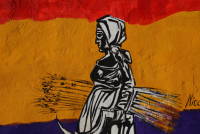
CONTROVERSY: ANARCHISTS IN THE SPANISH REVOLUTION by Sam Dolgoff In 1974, or early 1975, I reviewed in the English anarchist paper Freedom a book by Carlos Semprun Maura, Revolution and Counter-Revolution in Catalonia (French edition). In my review I criticized both Semprun Maura and Vernon Richards' book Lessons of the Spanish Revolution for presenting a distorted, over-simplified interpretation of events- a scenario. This provoked a heated rejoinder from Richards (three or four articles in Freedom). Over forty years after the tragic defeat of the Spanish Revolution - 1936 to 1939 - the question of anarchist participation in the Republican government and the role of anarchists in a revolution is a fundamental problem still debated- still r... (From : Flag.Blackened.net.)

Theory and Practice[Originally published in 1938 by Martin Secker and Warburg Ltd] Anarchism: Its Aims and Purposes; The Proletariat and the Beginning of the Modern Labor Movement; The Forerunners of Syndicalism; The Objectives of Anarcho-Syndicalism; The Methods of Anarcho-Syndicalism; The Evolution of Anarcho-Syndicalism. 1. Anarchism: Its Aims and Purposes Anarchism versus economic monopoly and state power; Forerunners of modern Anarchism; William Godwin and his work on Political Justice; P.J. Proudhon and his ideas of political and economic decentralization; Max Stirner's work, The Ego and Its Own; M. Bakunin the Collectivist and founder of the Anarchist movement; P. Kropotkin the exponent of Anarchist Communism and the philosophy of Mutual Aid; Anarchism and revolution; Anarchism a synthesis of Socialism and Liberalism; Anarchism versus economic materialism and Dictatorship; Anarchism and the state; Anarchism a tendency of his...

To most Americans Anarchy is an evil-sounding word -- another name for wickedness, perversity, and chaos. Anarchists are looked upon as a herd of uncombed, unwashed, and vile ruffians, bent on killing the rich and dividing their capital. Anarchy, however, to its followers actually signifies a social theory which regards the union of order with the absence of all government of man by man; in short, it means perfect individual liberty. If the meaning of Anarchy has so far been interpreted as a state of the greatest disorder, it is because people have been taught that their affairs are regulated, that they are ruled wisely, and that authority is a necessity. In by-gone centuries any person who asserted that mankind could get along without the ... (From : Anarchy Archives.)

A Pamphlet
Anarchy is a word that comes from the Greek, and signifies, strictly speaking, "without government": the state of a people without any constituted authority. Before such an organization had begun to be considered possible and desirable by a whole class of thinkers, so as to be taken as the aim of a movement (which has now become one of the most important factors in modern social warfare), the word "anarchy" was used universally in the sense of disorder and confusion, and it is still adopted in that sense by the ignorant and by adversaries interested in distorting the truth. We shall not enter into philological discussions, for the question is not philological but historical. The common interpretation of the word does not misconceive its tru... (From : Anarchy Archives.)

Published in Mother Earth on Nov. 5, 1907 in London by Int. Instituut Soc. Geschlodenis Amsterdam I HAVE often wondered why, with millions of people taking part in progressive and labor movements of all kinds, comparatively few accept Anarchism fully as we do. What is better known than the exploitation of labor by capital, the oppression of the individual by the State, to the student the least interested in social matters and to the practical observer of everyday life? Again, if Anarchist propaganda has not yet touched every remote place in all countries, there are numerous localities where it has been carried on for a generation and more, and even there it does not affect more than a certain proportion of the people. As long as I believed ... (From : Anarchy Archives.)

The general conception of the "type" American is in Europe picturesque and niave at the same time. In France as in Germany, in the Northern as in the Southern countries, in fact throughout the European Continent, with the exception of England perhaps, the opinion of the man in the street about America and Americans is primitive and inadequate. First of all, the name "an American" immediately suggests riches, wealth. It is almost as if American and rich man are synonyms, at least in the view of the average European who has never been in the United States and who seldom comes in direct contact with Americans in Europe. In the mind of most people the American is pictured as something very much different from the general run of men. He is very ... (From : Anarchy Archives.)

Foreword On May 26, 1958 at midnight, Chiu Tsai-kang, a steel worker of the Shanghai No. 3 Steel Works, was burned by molten steel. The affected area extended over 89 percent of his body, 20 percent being third degree burns with the muscles and bones involved. According to Western medical authorities, a patient with such severe burns would be likely to die. But due to the affectionate' concern of the Communist Party, to the great efforts made by the medical staff and to the widespread support of society at large, Chiu Tsai-kang is still alive. After being treated for more than five months his wounds are now completely healed and covered by grafted skin. On November 23 he was transferred to the Sino-Soviet Friendship Hospital in Peking for f... (From : Anarchy Archives.)

Johann Most's most famous speech. "Among the beasts of prey man is certainly the worst." This expression, very commonly made nowadays, is only relatively true. Not man as such, but man in connection with wealth is a beast of prey. The richer a man, the greater his greed for more. We may call such a monster the `beast of property." It now rules the world, making mankind miserable. and gains in cruelty and voracity with the progress of our so called `civilization " This monster we will in the following characterize and recommend to extermination. Look about ye! In every so-called "civilized" country there are among every 100 men about 95 more or less destitute and about 5 money-bags. It is unnecessary to trace all the sneaking ways by which t... (From : http://www.eclipse.net/~basket42/beast.html.)

Suggestions that I write my memoirs came to me when I had barely begun to live, and continued all through the years. But I never paid heed to the proposal. I was living my life intensely -- what need to write about it? Another reason for my reluctance was the conviction I entertained that one should write about one's life only when one had ceased to stand in the very torrent of it. "When one has reached a good philosophic age," I used to tell my friends, "capable of viewing the tragedies and comedies of life impersonally and detachedly -- particularly one's own life -- one is likely to create an autobiography worth while." Still feeling adolescently young in spite of advancing years, I did not consider myself competent to undertake such a task. Moreover, I always lacked the necessary leisure for concentrated writing. My enforced European inactivity left me enough time to read a great deal, including biographies and autobiographies. I discovered, much to my discomf...

IF I WERE to give a summary of the tendency of our times, I would say, Quantity. The multitude, the mass spirit, dominates everywhere, destroying quality. Our entire life--production, politics, and education--rests on quantity, on numbers. The worker who once took pride in the thoroughness and quality of his work, has been replaced by brainless, incompetent automatons, who turn out enormous quantities of things, valueless to themselves, and generally injurious to the rest of mankind. Thus quantity, instead of adding to life's comforts and peace, has merely increased man's burden. In politics, naught but quantity counts. In proportion to its increase, however, principles, ideals, justice, and uprightness are completely swamped by the array o... (From : Anarchy Archives.)

CHAPTER I DEPORTATION TO RUSSIA ON THE night of December 21, 1919, together with two hundred and forty-eight other political prisoners, I was deported from America. Although it was generally known we were to be deported, few really believed that the United States would so completely deny her past as an asylum for political refugees, some of whom had lived and worked in America for more than thirty years. In my own case, the decision to eliminate me first became known when, in 1909, the Federal authorities went out of their way to disfranchize the man whose name gave me citizenship. That Washington waited till 1917 was due to the circumstance that the psychologic moment for the finale was lacking. Perhaps I should have contested my case at that time. With the then-prevalent public opinion, the Courts would probably not have sustained the fraudulent proceedings which robbed me of citizenship. But it did not seem credible then that Ameri...

My Further Disillusionment in Russia By Emma Goldman Garden City, NY: Doubleday, Page & company; 1924 PREFACE The annals of literature tell of books expurgated, of whole chapters eliminated or changed beyond recognition. But I believe it has rarely happened that a work should be published with more than a third of it left out and-without the reviewers being aware of the fact. This doubtful distinction has fallen to the lot of my work on Russia. The story of that painful experience might well make another chapter, but for the present it is sufficient to give the bare facts of the case. My manuscript was sent to the original purchaser in two parts, at different times. Subsequently the publishing house of Doubleday, Page & Co. bought the rights to my work, but when the first printed copies reached me I discovered to my dismay that not only had my original title, "My Two Years in Russia," been changed to "My Disillusionment in...

WHAT is patriotism? Is it love of one's birthplace, the place of childhood's recollections and hopes, dreams and aspirations? Is it the place where, in childlike naivety, we would watch the fleeting clouds, and wonder why we, too, could not run so swiftly? The place where we would count the milliard glittering stars, terror-stricken lest each one "an eye should be," piercing the very depths of our little souls? Is it the place where we would listen to the music of the birds, and long to have wings to fly, even as they, to distant lands? Or the place where we would sit at mother's knee, enraptured by wonderful tales of great deeds and conquests? In short, is it love for the spot, every inch representing dear and precious recollections of a h... (From : Anarchy Archives.)

It is evident that we are advancing rapidly towards revolution, towards an upheaval that will begin in one country and spread, as in 1848, into all the neighboring lands, and, as it rocks existing society to its foundations, will also reopen the springs of life. To confirm our view, we do not even have to invoke the testimony of a celebrated German historian, or a well-known Italian philosopher, both of whom, having deeply studied the history of our times, have reached the conclusion that a great revolution was inevitable towards the end of this century. We need only watch the panorama that has unrolled before us over the past twenty years; we need only observe what goes on around us. When we do so, we perceive two major facts emerging from the murky depths of the canvas: the awakening of the peoples, in contrast to the moral, intellectual and economic failure of the ruling classes; and the agitated yet powerless efforts of people of wealth to hinder...