
A MATTER OF WORDS The word anarchy is as old as the world. It is derived from two ancient Greek words, av (an), apxn (arkhe), and means something like the absence of authority or government. However, for millennia the presumption has been accepted that man cannot dispense with one or the other, and anarchy has been understood in a pejorative sense, as a synonym for disorder, chaos, and disorganization. Pierre-Joseph Proudhon was famous for his quips (such as "property is theft") and took to himself the word anarchy. As if his purpose were to shock as much as possible, in 1840 he engaged in the following dialogue with the "Philistine." "You are a republican." "Republican, yes; but that means nothing. Res publica is 'the State.' Kings, too, are republicans." "Ah well! You are a democrat?" "No." "What! Perhaps you are a monarchist?" "No." "Constitutionalist then?" "God forbid." "Then you are an aristocrat?" "Not at...

From the upcoming "No Gods, No Masters" edited by Daniel Guerin, to be published by AK Press the summer of 1997 Anarchists Behind Bars (Summer 1921) by Gaston Leval Once I discovered that there were so many of our comrades in prison, I arranged, together with the French syndicalist delegates to make overtures to Dzerzhinsky, the People's Commissar for the Interior, implicitly obedient to Lenin. Being wary of me, my fellow delegates chose Joaquin Maurin to speak on behalf of the CNT delegation. Maurin reported back on their first audience. At the sight of the list of the prisoners whose release was being sought, Dzerzhinsky blanched, then went red with fury, arguing that these men were counterrevolutionaries in cahoots with the White general... (From : Anarchy Archives.)
From: G.P. Maximoff, Syndicalists in the Russian Revolution The Author GREGORI PETROVICH MAXIMOFF was born on November 10, 1893, in the Russian village of Mitushino, province of Smolensk. After studying for the priesthood, he realized this was not his vocation and went to St. Petersburg, where he graduated as an agronomist at the Agricultural Academy in 1915. He joined the revolutionary movement, while a student, was an active propagandist and, after the 1917 revolution, joined the Red Army. When the Bolsheviks used the Army for police work and for disarming the workers, he refused to obey orders and was sentenced to death. The solidarity of the steelworkers' union saved his life. He edited the Anarcho-Syndicalist papers Golos Trouda (Voice... (From : Anarchy Archives.)

The Commissar of our ossobniak, having to lay in provisions, invited me to accompany him to the Moskkommune. It is the great food supply center, a tremendous organization that feeds Moscow and its environs. Its trains have the right of way on all lines and carry food from parts as distant as Siberia and Turkestan. Not a pound of flour can be issued by any of the "stores" --- the distributing points scattered throughout the city --- without a written order signed and counter-signed by the various bureaus of the Commune. From this center each "distributor" receives the amount necessary to supply the demands of the given district, according to the norm allowed on the bread and other cards. The Moskkommune is the most popular and active institution; it is a beehive swarming with thousands of employes, busy determining the different categories of pyock and issuing "authorizations." Besides the bread rations, sugar, tea, etc., given to the citizen by...

EARLY DAYS: Life at home and school in St. Petersburg. My bourgeois father and aristocratic mother. Jews and gentiles. I question my father about the Turkish prisoners of war begging alms in the streets. OUR FAMILY SKELETON: Strange rumors about my mother and her brother Maxim. Echoes of the Polish rebellion of 1863. I hear of the dreaded Nihilists and revolution. A TERRIFIED HOUSEHOLD: A bomb explodes as I recite my lesson in school. The assassination of Czar Alexander II. Secret groups in our class. Police search our house. Uncle Maxim is arrested for conspiring against the Czar's Life. The funeral of the dead Czar. A terrorized city. FAMILY TROUBLES: Rumors of my beloved Uncle Maxim's execution. My terrible grief. Death of my father. We ... (From : Anarchy Archives.)

March 7th is a harrowing date for the toilers of the so-called "Union of Soviet Socialist Republics" who participated in one capacity or another in the events that occurred on that date in Kronstadt. The commemoration of that date is equally painful for the toilers of all countries, for it brings back the memory of what the free workers and sailors of Kronstadt demanded of their Red executioner, the "Russian Communist Party," and its tool, the "Soviet" government, busy doing the Russian revolution to death. Kronstadt insisted of these statist hangmen that they hand back everything that belonged to the toilers of town and country, given that it was they who had carried out the revolution. The Kronstadters insisted upon the practical implemen... (From : NestorMakhno.info.)

Note: This piece was printed in Alternative Forum, Vol. 1, No. 1, Fall, 1991 INTELLIGENTSIA AND THE NEW INTELLECTUALS By Murray Bookchin Editorial Introduction: The following lecture was delivered as the opening address at the fourth continental Youth Greens conference that took place on the campus of Goddard College in Vermont on July 27,1990 The social theorist Murray Bookchin, whose work on ecology began with an article on the chemical additives in food in 1952, is a long-standing activist in the ecology movement and the author of several books, including The Ecology of Freedom, Remaking Society and The Philosophy of Social Ecology. In many ways, this confrontational and thought-provoking address expresses some of the most difficult prob... (From : Anarchy Archives.)
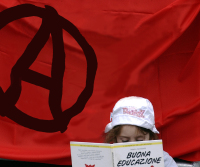
From my copy of Alexander Berkman's The Kronstadt Rebellion, Berlin: Der Sindikalist, 1922. Russian Revolution Series The Kronstadt Rebellion By Alexander Berkman Fifteen Cents 1922 I. LABOR DISTURBANCES IN PETROGRAD It was early in 1921. Long years of war, revolution, and civil struggle had bled Russia to exhaustion and brought her people to the brink of despair. But at last civil war was at an end: the numerous fronts were liquidated, and Wrangel -- the last hope of Entente intervention and Russian counter-revolution -- was defeated and his military activities within Russia terminated. The people now confidently looked forward to the mitigation of the severe Bolshevik régime. It was expected that with the end of civil war the Commu... (From : Anarchy Archives.)

Living My Life by Emma Goldman Volume one New York: Alfred A Knopf Inc., 1931. Chapter 7 At the International Socialist Congress held in Paris in 1889 the decision had been made to turn the first of May into a world-wide holiday of labor. The idea caught the imagination of the progressive workers in every land. The birth of spring was to mark the reawakening of the masses to new efforts for emancipation. In this year, 1891, the decision of the Congress was to find wide application. On the first of May the toilers were to lay down their tools, stop their machines, leave the factories and mines. In festive attire they were to demonstrate with their banners, marching to the inspiring strains of revolutionary music and song. Everywhere meetings were to take place to articulate the aspirations of labor. The Latin countries had already begun their preparations. The socia...

MY FURTHER DISILLUSIONMENT IN RUSSIA By Emma Goldman, Garden City, NY: Doubleday, Page & Company; 1924 CHAPTER I ODESSA AT THE numerous stations between Kiev and Odessa we frequently had to wait for days before we managed to make connections with trains going south. We employed our leisure in visiting the small towns and villages, and formed many acquaintances. The markets were especially of interest to us. In the Kiev province by far the greater part of the population is Jewish. They had suffered many pogroms and were now living in constant terror of their repetition. But the will to live is indestructible, particularly in the Jew; otherwise centuries of persecution and slaughter would long since have destroyed the race. Its peculiar perseverance was manifest everywhere: the Jews continued to trade as if nothing had happened. The news that Americans were in town would quickly gather about us crowds of people anxi...

March is a historic month: in the struggle of mankind against the power of darkness and oppression it has frequently played a very significant role. But the most important March event of modern times is of comparatively recent date. It took place in Russia just ten years ago in 1921, and is known as the Kronstadt Rebellion. In many of its characteristics the Kronstadt Rebellion had great similarity with another great historic uprising, namely that of the proletariat of Paris in 1870, which is known as the Paris Commune. The month of March is the anniversary of the Paris Commune, as well the as the Kronstadt Rebellion, and it is fitting that the two great events be celebrated at the same time. I say " celebrated" advisedly. For though Kronst... (From : Anarchy Archives.)
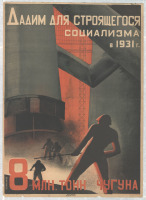
PREFACE Clarity of ideas is not characteristic of the average mind. Many people still continue to think and to talk of the Russian Revolution and of the Bolsheviki as if the two were identical. In other words, as if nothing had happened in Russia during the last three years. The great need of the present is to make clear the difference between that grand social event and the ruling, political party --- a difference as fundamental as it has been fatal to the Revolution. The following pages present a clear and historically true picture of the ideals that inspired the Revolution, and of the role played by the Bolsheviki. This pamphlet conclusively proves what the Russian Revolution IS and what the BoIshevik State, alias the Communist Party, IS... (From : Anarchy Archives.)
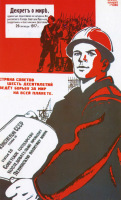
The Russian Revolution Series No.1 The RUSSIAN TRAGEDY (A Review and An Outlook) by Alexander Berkman FOREWORD We live at a time when two civilizations are struggling for their existence. Present society is at death grips with the New Ideal. The Russian Revolution was but the first serious combat of the two forces, whose struggle must continue till the final triumph of the one or of the other. The Russian Revolution has failed - failed of its ultimate purpose. But that failure is a temporary one. In the point of revolutionizing the thought and feeling of the masses of Russia and of the world, in undermining the fundamental concepts of existing society, and lighting the torch of faith and hope for the Better Day, the Russian Revolution has b... (From : Anarchy Archives.)

The month of October 1917 is a great historical watershed in the Russian revolution. That watershed consists of the awakening of the toilers of town and country to their right to seize control of their own lives and their social and economic inheritance; the cultivation of the soil, the housing, the factories, the mines, transportation, and lastly the education which had hitherto been used to strip our ancestors of all these assets. However, as we see it, it would be wide of the mark if we were to see all of the content of the Russian revolution encapsulated in October: in fact, the Russian revolution was hatched over the preceding months, a period during which the peasants in the countryside and the workers in the towns grasped the essential point. Indeed, the revolution of February 1917 came to be a symbol for the toilers of their economic and political liberation. However, they quickly noticed that the February revolution as it evolved adopted the degenerated format cha...
"Discussing the activities and role of the Anarchists in the Revolution, Kropotkin said: 'We Anarchists have talked much of revolutions, but few of us have been prepared for the actual work ,to be done during, the process. I have indicated some things in this relation in my Conquest of Bread. Pouget and Pataud have also sketched a line of action in their work on Syndicalism and the Cooperative Commonwealth. Kropotkin thought that the Anarchists had not given sufficient to the fundamental elements of the social revolution. The real facts in a revolutionary process do not consist so much in actual fighting--that is, merely the destructive phase necessary to clear the way for constructive effort. The basic factor in a revolution is the organiz... (From : Anarchy Archives.)

TROTSKY PROTESTS TOO MUCH By Emma Goldman . PRICE TWOPENCE In America Five Cents Published by THE ANARCHIST COMMUNIST FEDERATION INTRODUCTION. This pamphlet grew out of an article for Vanguard, the Anarchist monthly published in New York City. It appeared in the July issue, 1938, but as the space of the magazine is limited, only part of the manuscript could be used. It is here given in a revised and enlarged form. Leon Trotsky will have it that criticism of his part in the Kronstadt tragedy is only to aid and abet his mortal enemy, Stalin. It does not occur to him that one might detest the savage in the Kremlin and his cruel regime and yet not exonerate Leon Trotsky from the crime against the sailors of Kronstadt. In point of trut... (From : Anarchy Archives.)
Foreword Independently of the reactions towards the right [which took place in Russia after the October Revolution of 1917] there also occurred, during and after the same period, a series of movements in the opposite direction. These were revolutionary movements, which fought the Bolshevik power in the name of true liberty and of the principles of the Social Revolution which that power had scoffed at and trampled underfoot. Indeed, even within the ranks of the government and of the Communist Party itself, movements of opposition and revolt were provoked by the stifling statism and centralism, the terrifying tendency towards bureaucracy, the flagrant social impotence and the shameless violence of the Bolsheviks. It was thus that, in the summer of 1918, the Left Social-Revolutionaries, who until then had participated in the government, left it, broke with the Bolsheviks, and declared against them. They soon succumbed under the blows of repression.

Alexander Berkman died 61 years ago on June 28th, 1936. We enclose here his editorial for the first issue of The Blast published in San Francisco on 15th January 1916. Why The Blast? Do you mean to destroy? Do you mean to build? These are questions we have been asked from any quarters, by inquirers sympathetic and otherwise. Our reply is frank and bold: We mean both: to destroy and to build. For, socially speaking, Destruction is the beginning of Construction. Superficial minds speak sneeringly of destruction. O, it is easy to destroy -they say- but to build, to build, that’s the important work. Its nonsense. No structure, social or otherwise, can endure if built on a foundation of lies. Before the garden can bloom, the weeds must be u... (From : Kate Sharpley Library.)