
Ideas are true liberators. Ideas as distinguished from so-called reason. For in our work-a-day world there is much reason and too little thought. It is given only to the seer and poet to conceive liberating ideas - impractical, wild thoughts that ultimately light the way of practical, blind man to better and higher endeavor. To "practical" minds the regeneration of the world is an empty dream. To transform the cold winter of our age into the warmth of a beautiful summer day, to change our valley of tears and misery into a luxurious garden of joy is a vain fantasy lacking reason and sanity. But a William Morris sees in his mind's eye a world of comradeship and brotherhood rejoicing in the plenitude of earth's bounty, and he challenges "pract... (From : Anarchy Archives.)

On October 12 Dr. Merlino opened the meeting by reading a paper on "The Organization of Labor." He dwelt upon the necessity of revising the whole system of the production of the necessaries of life, and pointed out that if this was done by a government it would be an artificial organization of labor, whereas in a period of the development of society a free-handed policy was a necessity. Of course the usual objection would be made to this opinion. It would be asked, How without a central government can the workmen organize themselves? What would be their guides? He replied, reason and interest. People would begin to use their reason and to trust in it more than they do at the present day. It was necessary that people should know something of... (From : AnarchyArchives.)

On the 5th of May last the celebration of the centenary of the French Revolution began by the commemoration of the opening of the States-General at Versailles, at the same date, in the memorable year of 1789. And Paris—that city which in January last so clearly manifested its dissatisfaction with Parliamentary rule—heartily joined in the festivities organized to celebrate a day when parliamentary institutions, crossing the Channel, went to take firm root on the Continent. Must we see in the enthusiasm of the Parisians one of those seeming contradictions which are so common in the complicated life of large human agglomerations? Or was it the irresistible attraction of a spring festival which induced the Parisians to rush in flock... (From : Anarchy Archives.)

The Russian Language--Early folk literature: Folklore-- Songs-Sagas-Lay of Igor's Raid-Annals-The Mongol Invasion; its consequences-Correspondence between John IV. and Kúrbiskíy-Split in the Church-Avvakúm's Memoirs- The eighteenth century: Peter I. and his contemporaries-Tretiakóvsky-Lomonósoff-Sumarókoff-The times of Catherine II.-Derzhávin-Von Wízin-The Freemasons: Novikóff; Radíscheff-Early nineteenth century: Karamzín and Zhukóvskiy-The Decembrists-Ryléeff. One of the last messages which Turguéneff addressed to Russian writers from his death-bed was to implore them to keep in its purity "that precious inheritance of ours.-the Russian Language." He who knew in perfection most...

“And note, also, this falsehood, of which all are guilty; the way in which marriages are made. What could there be more natural? The young girl is marriageable, she should marry. What simpler, provided the young person is not a monster, and men can be found with a desire to marry? Well, no, here begins a new hypocrisy. “Formerly, when the maiden arrived at a favorable age, her marriage was arranged by her parents. That was done, that is done still, throughout humanity, among the Chinese, the Hindus, the Mussulmans, and among our common people also. Things are so managed in at least ninety-nine per cent. of the families of the entire human race. “Only we riotous livers have imagined that this way was bad, and have invented another. And this other,—what is it? It is this. The young girls are seated, and the gentlemen walk up and down before them, as in a bazaar, and make their choice. The maidens wait and think, but do not dare to say: ‘...

From Meet Kropotkin. The Salvation Series No. 1. Bombay: The Libertarian Book House, n.d. KROPOTKIN - THE MASTER by HERBERT READ. PRINCE PETER ALEXEIVICH KROPOTKIN was born at Moscow on the 9th December, 1842 (o. s.). His father, Prince Alexei Petrovich Kropotkin, is described by Kropotkin as "a typical officer of the time of Nicholas I", but he seems to have been an easy-going parent, content to leave his son's education to his French tutor until it was time to send him off to a military academy. Kropotkin's mother was the youngest daughter of the commander of a Cossack army corps, General Sulima, and a woman of great refinement and sensibility, qualities which her son must have inherited, for she died before she had time to influence him ... (From : Anarchy Archives.)

When I was in my eighth year, the next step in my career was taken, in a quite unforeseen way. I do not know exactly on what occasion it happened, but probably it was on the twenty-fifth anniversary of Nicholas I.'s accession, when great festivities were arranged for at Moscow. The imperial family were coming to the old capital, and the Moscow nobility intended to celebrate this event by a fancy-dress ball, in which children were to play an important part. It was agreed that the whole motley crowd of nationalities of which the population of the Russian Empire is composed should be represented at this ball to greet the monarch. Great preparations went on in our house, as well as in all the houses of our neighborhood. Some sort of remarkable Russian costume was made for our stepmother. Our father, being a military man, had to appear, of course, in his uniform; but those of our relatives who were not in the military service were as busy with their Russian, Greek, Caucasian,...
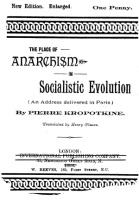
Part 1 You must often have asked yourselves what is the cause of Anarchism, and why, since there are already so many Socialist schools, it is necessary to found an additional one -- that of Anarchism. In order to answer this question I will go back to the close of last century. You all know the characteristics which marked that epoch: there was all expansion of intelligence a prodigious development of the natural sciences, a pitiless examination of accepted prejudices, the formation of a theory of Nature based on a truly scientific foundation, observation and reasoning. In addition to these there was criticism of the political institutions bequeathed to Humanity by preceding ages, and a movement towards that ideal of Liberty, Equality, and ... (From : Anarchy Archives.)
The last students' disturbances in Russia were quite different from all the disturbances which have taken place in the Russian universities for the last forty years. They began, as all students' movements begin, with an insignificant incident, which concerned the students alone; but, owing to a series of circumstances quite peculiar to Russia, they took, all of a sudden, a political complexion; and in this respect they acquired such a significance that they will now count in the history of the constitutional movement in Russia as an important milestone. Consequently it is impossible to speak of the last events without going deeper than their surface — that is, without touching upon the general problem of education in Russia, and witho... (From : Anarchy Archives.)

Again there are murders, again disturbances and slaughter in the streets, again we shall have executions, terror, false accusations, threats and anger on the one side; and hatred, thirst for vengeance, and readiness for self-sacrifice, on the other. Again all Russians are divided into two hostile camps, and are committing and preparing to commit the greatest crimes. Very possibly the disturbances that have now broken out may be suppressed, though it is also possible that the troops of soldiers and of police, on whom the Government place such reliance, may realize that they are being called on to commit the terrible crime of fratricide-and may refuse to obey. But even if the present disturbance is suppressed, it will not be extinguished, but... (From : Anarchy Archives.)