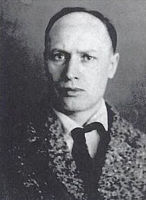
(1886 - 1937) ~ Russian, Anarchist Revolutionary and Makhnovist Partisan : In prison he met Makhno. Both Makhno and Arshinov were released in 1917 and Arshinov joined Makhno in the Ukraine when the Makhnovite Insurrectionary Army took control. (From : Anarchy Archives.)
• "The question for anarchists of all countries is the following: can our movement content itself with subsisting on the base of old forms of organization, of local groups having no organic link between them, and each acting on their side according to its particular ideology and particular practice?" (From : "The Old and New in Anarchism: A Reply to Comrade ....)
• "Libertarian communism cannot linger in the impasse of the past; it must go beyond it, in combating and surmounting its faults." (From : "The Old and New in Anarchism: A Reply to Comrade ....)
• "For the masses sense the futility of contradictory notions and avoid them instinctively; in spite of this, in a revolutionary period, they act and live in a libertarian fashion." (From : "The Old and New in Anarchism: A Reply to Comrade ....)

The ResurrectionOne of the most popular superstitions consists in the belief that every man is endowed with definite qualities—that some men are kind, some wicked; some wise, some foolish; some energetic, some apathetic, etc. This is not true. We may say of a man that he is oftener kind than wicked; oftener wise than foolish; oftener energetic than apathetic, and vise versa. But it would not be true to say of one man that he is always kind or wise, and of another that he is always wicked or foolish. And yet we thus divide people. This is erroneous. Men are like rivers—the water in all of them, and at every point, is the same, but every one of them is now narrow, now swift, now wide, now calm, now clear, now cold, now muddy, now warm. So it is with men. Every man bears within him the germs of all human qualities, sometimes manifesting one quality, sometimes another; and often does not resemble himself at all, manifesting no change. With some people these changes are pa...

Numbers of Prisoners. Overcrowding.--From an official document communicated to the State Council on March 15, 1909, by the administration of the prisons, it appears that on February 1, 1909, there were in the lock-ups of the Empire 181,137 inmates. This figure, however, does not include those prisoners who are in transportation, and the numbers of whom are estimated officially at about 30,000. Nor does it include an immense number of persons detained at the police lock-ups, both in the towns and in the villages. No approximate idea as to the number of this last category can be obtained, but it has been suggested in the Russian Press that it may be anything between 50,000 and 100,000. The worst is that it is especially in the Police lock-ups that the ill-treatment of the prisoners is the most awful. The famous torture chambers of Grinn at Warsaw, and Gregus at Riga (both condemned by courts) were precisely police lock-ups. The number of inmates...