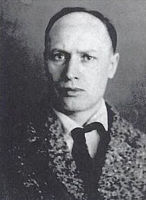
(1886 - 1937) ~ Russian, Anarchist Revolutionary and Makhnovist Partisan : In prison he met Makhno. Both Makhno and Arshinov were released in 1917 and Arshinov joined Makhno in the Ukraine when the Makhnovite Insurrectionary Army took control. (From : Anarchy Archives.)
• "Libertarian communism cannot linger in the impasse of the past; it must go beyond it, in combating and surmounting its faults." (From : "The Old and New in Anarchism: A Reply to Comrade ....)
• "For the masses sense the futility of contradictory notions and avoid them instinctively; in spite of this, in a revolutionary period, they act and live in a libertarian fashion." (From : "The Old and New in Anarchism: A Reply to Comrade ....)
• "The question for anarchists of all countries is the following: can our movement content itself with subsisting on the base of old forms of organization, of local groups having no organic link between them, and each acting on their side according to its particular ideology and particular practice?" (From : "The Old and New in Anarchism: A Reply to Comrade ....)

The Resurrection"Walk in, Your Excellency, you are expected," said the fat porter, pushing open the swinging, oaken door of the entrance. "They are dining, but I was told to admit you." The porter walked to the stairway and rang the bell. "Are there any guests?" Nekhludoff asked, while taking off his coat. "Mr. Kolosoff, also Michael Sergeievich, besides the family," answered the porter. A fine-looking lackey in dress coat and white gloves looked down from the top of the stairs. "Please to walk in, Your Excellency," he said. Nekhludoff mounted the stairs, and through the spacious and magnificent parlor he entered the dining-room. Around the table were seated the entire family, except Princess Sophia Vasilievna, who never left her own apartments. At the head of the table sat old Korchagin, on his left the physician; on his right, a visitor, Ivan Ivanovich Kolosoff, an ex-district commander, and now a bank manager, who was a friend of the...

The present conditions in Russia are so desperate that it is a public duty to lay before this country a statement of these conditions, with a solemn appeal to all lovers of liberty and progress for moral support in the struggle that is now going on for the conquest of political freedom. In the struggle for freedom each country must work out its own salvation; but we should not forget that there exists a web of international solidarity between all civilized countries. It is true that the loans contracted by the heads of despotic states in foreign countries contribute to support despotism. But Russian exiles also know from their own experience how the moral support which the fighters for liberty have never failed to find in the enlightened portions of the civilized nations has been helpful to them, and how much it has aided them to maintain faith in the ultimate victory of freedom and justice. It has been decided, therefore, to issue the present statement,in...