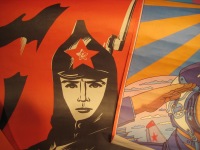
It must be left to the future historian to determine whether the Bolshevik repression of the bourgeoisie, with which they started, their rule, was not merely a means towards the ulterior purpose of suppressing all the other non-Bolshevik elements. For the Russian bourgeoisie was not really dangerous to the Revolution. As is well known, it was an insignificant minority, unorganized, without definite solidaric interests and entirely powerless. The revolutionary elements, on the contrary, were a real obstacle to the dictatorship of any political party. The elimination of the revolutionary elements would be of prime necessity to any dictatorship, because such a dictatorship would meet with the strongest opposition NOT from the bourgeoisie but f... (From : Anarchy Archives.)

Chapter III DISTURBING THOUGHTS LIFE went on. Each day brought new conflicting thoughts and emotions. The feature which affected me most was the inequality I witnessed in my immediate environment. I learned that the rations issued to the tenants of the First House of the Soviet (Astoria) were much superior to those received by the workers in the factories. To be sure, they were not sufficient to sustain life--but no one in the Astoria lived from these rations alone. The members of the Communist Party, quartered in the Astoria, worked in Smolny, and the rations in Smolny were the best in Petrograd. Moreover, trade was not entirely suppressed at that time. The markets were doing a lucrative business, though no one seemed able or willing to explain to me where the purchasing capacity came from. The workers could not afford to buy butter which was then 2,000 rubles a pound, sugar at 3,000, or meat at 1,000. The inequality was most apparent in th...

My Further Disillusionment in Russia By Emma Goldman Garden City, NY: Doubleday, Page & company; 1924 PREFACE The annals of literature tell of books expurgated, of whole chapters eliminated or changed beyond recognition. But I believe it has rarely happened that a work should be published with more than a third of it left out and-without the reviewers being aware of the fact. This doubtful distinction has fallen to the lot of my work on Russia. The story of that painful experience might well make another chapter, but for the present it is sufficient to give the bare facts of the case. My manuscript was sent to the original purchaser in two parts, at different times. Subsequently the publishing house of Doubleday, Page & Co. bought the rights to my work, but when the first printed copies reached me I discovered to my dismay that not only had my original title, "My Two Years in Russia," been changed to "My Disillusionment in...
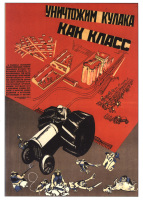
Translators Introduction The Ukrainian peasant anarchist Nestor Makhno visited Moscow in June 1918 and was granted extensive interviews with the Bolshevik leaders Sverdlov and Lenin. Many years later Makhno, an exile in France, wrote his memoirs of the tumultuous years 1917-18. "My Visit to the Kremlin" is a translation of the two chapters which deal with his encounters with the Bolshevik titans. Excerpts from these interviews have been quoted in various works in English but the full account was presented here for the first time . (i) (This pamphlet was sent by us to a Moscow publisher in 1992 and will appear in a re-translated edition in Russia for the first time simultaneously with this new edition - 1993 note). Moscow in June 1918 In Jun... (From : NestorMakhno.info.)
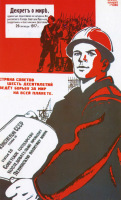
The Russian Revolution Series No.1 The RUSSIAN TRAGEDY (A Review and An Outlook) by Alexander Berkman FOREWORD We live at a time when two civilizations are struggling for their existence. Present society is at death grips with the New Ideal. The Russian Revolution was but the first serious combat of the two forces, whose struggle must continue till the final triumph of the one or of the other. The Russian Revolution has failed - failed of its ultimate purpose. But that failure is a temporary one. In the point of revolutionizing the thought and feeling of the masses of Russia and of the world, in undermining the fundamental concepts of existing society, and lighting the torch of faith and hope for the Better Day, the Russian Revolution has b... (From : Anarchy Archives.)

Chapter 4. Some Reflections Naturally the popular masses could not recognize all the subtleties of these different interpretations. It was impossible for them — even when they had made some contact with our ideas — to understand the real significance of the differences in question. The Russian workers, of all the workers in the world, were the least familiar with political matters. They could not be aware either of the machiavellianism or the danger of the Bolshevik interpretation. I recall the desperate efforts with which I tried to warn the city workers, in so far as it was possible, by word of mouth and by writing, of the imminent danger for the true Revolution in the event that the masses let the Bolshevik Party entrench itself solidly in power. In vain I argued; the masses did not recognize the danger. How many times did they object in words like these: “Comrade, we understand you well. And moreover, we are not too confid...