While presidents almost always expand the power of their office and of the government, Donald Trump is likely to enact a degree of barefisted authoritarianism the modern United States is totally unprepared for. Even if the corrupt and limp political elites that have so far utterly failed to stand against him unexpectedly rally a steadfast resistance in Congress Trump will still enter office with the overwhelming backing of rank and file law enforcement. A strongman unburdened by any conditioning of social norms or sufficient intelligence to understand game theoretic constraints. A man who the NYTimes reported “privately muses about all the ways he will punish his enemies after Election Day.” Never mind the wild geopolitical catastrophes as yet undreamed, those of us in the belly of the beast have more immediate concerns to look forward to. Trump’s promised “law and order” presidency would mean a Christmas list of presents... (From : TheAnarchistLibrary.org.)
A Note from Solidarity We are pleased to bring our readers a further installment, in English, of Marxisme et Théorie Révolutionnaire by Cornelius Castoriadis (Paul Cardan). The original French text appeared (between 1961 and 1964) in issues 36–40 of the now defunct journal Sociallsme ou Barbarie. The first chapter of Marxisme et Théorie Revolutionnaire (‘La situation historique du marxisme et la question d’orthodoxie’) was first published in English by Solidarity (London) in 1966 (vol. IV, no. 3) under the title The Fate of Marxism. It was later reprinted as a pamphlet. We published the second chapter (’La théorie Marxiste de l’histoire’) in 1971, calling it ‘History and Revolution.’ The pamphlet in your hands consists of chapters 3 and 4 (entitled respectively ‘La philosophie Marxiste de l’histoire’ and ‘Les deux el... (From : TheAnarchistLibrary.org.)
Why should we, the proletarians, have children if they are taken by the capitalists to be killed metaphorically in work and by the militarists to be killed in reality as soldiers? Antinatalism (http://en.wikipedia.org/wiki/Antinatalism) is a philosophy with a centuries-long history that is against the birth of new fetuses in the human society for ethical and philosophical reasons. Antinatalists believe that the existence in life will necessarily cause a person to live negative experiences, and use two philosophical positions to support the idea that the birth of new humans is a bad thing: 1. The philosophy of Hedonism (http://en.wikipedia.org/wiki/Hedonism) that says that the meaning of life is happiness. 2. The position that since the meaning of life is happiness, we shall not make other people unhappy. Having in mind the above positions, and knowing that the existence in life necessarily causes a person to l... (From : TheAnarchistLibrary.org.)
I can only be amused when the religious mindset insinuates itself into the viewpoints of those who claim to oppose this society, filling these radicals of various types with its binaries, its puritanical/moralistic thinking, its renunciations and its judgments. It is not so surprising when this occurs. After all, if one doesn’t launch her challenge against this society from herself, but rather from an ideal placed above himself, he inevitably confronts the world as a righteous judge aiming to condemn and punish rather than as an enemy aiming to defeat and conquer. Therefore, this moral challenger has no choice but to absolutely reject everything that she has come to associate with this world and to embrace everything he has come to associate with the ideal. This can be particularly entertaining when the world that is opposed is something as broad as civilization and the ideal is something as ethereal and abstract as “wildness”. The amusement stems from the fact... (From : TheAnarchistLibrary.org.)
Direct action—that is, any kind of action that bypasses established political channels to accomplish objectives directly—has a long and rich heritage in North America, extending back to the Boston Tea Party and beyond. Despite this, there are many misunderstandings about it, in part due to the ways it has been misrepresented in the corporate media. 1. Direct action is terrorism. Terrorism is calculated to intimidate and thus paralyze people. Direct action, on the other hand, is intended to inspire and thus motivate people by demonstrating the power individuals have to accomplish goals themselves. While terrorism is the domain of a specialized class that seeks to acquire power for itself alone, direct action demonstrates possibilities that others can make use of, empowering people to take control of their own lives. At most, a given direct action may obstruct the activities of a corporation or institution that activists perceive to be committing an i... (From : TheAnarchistLibrary.org.)
(1896 - 1978)
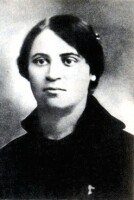
Agafya "Halyna" or "Galina" Andreyevna Kuzmenko Makhno (Ukrainian: Галина Андріївна Кузьменко, Russian: Агафья (Галина) Андреевна Кузьменко; 1896–1978) was a Ukrainian teacher and anarchist, and the wife of Nestor Makhno. Halyna Kuzmenko was, according to most sources, born in 1896 in Kiev in what was then the Russian Empire. After her birth, her parents moved to the village of Pichtchany Brid in the Yekaterinoslav Governorate, in what is now Kirovohrad Oblast in central Ukraine. Other sources claim that she was born in 1892, in Pichtchany Brid. Her father, a former farmer, worked as a policeman. During her higher education, s... (From : Wikipedia.org.)
(1864 - 1930)
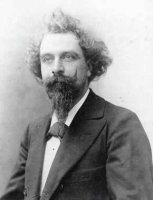
Alphonse Gallaud de la Pérouse (28 May 1864 – 30 August 1930), better known as Zo d'Axa (French pronunciation: [zo daksa]), was a French adventurer, anti-militarist, satirist, journalist, and founder of two of the most legendary French magazines, L'EnDehors and La Feuille. A descendant of the famous French navigator Jean-François de Galaup, comte de Lapérouse, he was one of the most prominent French individualist anarchists at the turn of the 20th century. (From : Wikipedia.org.)
We are a revolutionary anarchist communist organization made up of local groups and individuals who seek a complete transformation of society, and the creation of anarchist communism. This will mean the working class overthrowing capitalism, abolishing the State, getting rid of exploitation, hierarchies and oppressions, and halting the destruction of the environment. To contribute to the building of a revolutionary anarchist movement we believe it is important to be organized. We are committed to building an effective national and international organization that has a collective identity and works towards the common goal of anarchist communism, whilst at the same time working together with other working class organizations and in grass roots campaigns. We do not see ourselves as the leaders of a revolutionary movement but part of a wider movement for revolutionary change. In addition, we strive to base all our current actions on the principles that will be the basis of the... (From : AnarchistCommunism.org.)
(1954 - )
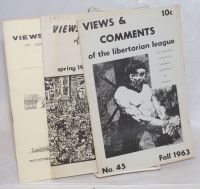
The Libertarian League was founded in New York City in 1954 as a political organization building on the Libertarian Book Club. Members included Sam Dolgoff, Russell Blackwell, Dave Van Ronk, Enrico Arrigoni and Murray Bookchin. This league had a narrower political focus than the first, promoting anarchism and syndicalism. Its central principle, stated in its journal Views and Comments, was "equal freedom for all in a free socialist society". Branches of the League opened in a number of other American cities, including Detroit and San Francisco. It was dissolved at the end of the 1960s. (From : Wikipedia.org.)
Or, the Wrongs of WomanAbodes of horror have frequently been described, and castles, filled with specters and chimeras, conjured up by the magic spell of genius to harrow the soul, and absorb the wondering mind. But, formed of such stuff as dreams are made of, what were they to the mansion of despair, in one corner of which Maria sat, endeavoring to recall her scattered thoughts! Surprise, astonishment, that bordered on distraction, seemed to have suspended her faculties, till, waking by degrees to a keen sense of anguish, a whirlwind of rage and indignation roused her torpid pulse. One recollection with frightful velocity following another, threatened to fire her brain, and make her a fit companion for the terrific inhabitants, whose groans and shrieks were no unsubstantial sounds of whistling winds, or startled birds, modulated by a romantic fancy, which amuse while they affright; but such tones of misery as carry a dreadful certainty directly to the heart. What effect must they then have prod...
Why do you clothe me with scarlet of shame? Why do you point with your finger of scorn? What is the crime that you hissingly name When you sneer in my ears, "Thou bastard born?" Am I not as the rest of you, With a hope to reach, and a dream to live? With a soul to suffer, a heart to know The pangs that the thrusts of the heartless give?" I am no monster! Look at me -- Straight in my eyes, that they do not shrink! Is there aught in them you can see To merit this hemlock you make me drink? This poison that scorches my soul like fire, That burns and burns until love is dry, And I shrivel with hate, as hot as a pyre, A corpse, while its smoke curls up to the sky? Will you touch my hand? It is flesh like yours; Perhaps a little more brown and grimed, For it could not be white while the drawers' and hewers', My brothers, were calloused and darkened and slimed. Ye... (From : Anarchy Archives.)
With Strictures On Political And Moral SubjectsM. Wollstonecraft was born in 1759. Her father was so great a wanderer, that the place of her birth is uncertain; she supposed, however, it was London, or Epping Forest: at the latter place she spent the first five years of her life. In early youth she exhibited traces of exquisite sensibility, soundness of understanding, and decision of character; but her father being a despot in his family, and her mother one of his subjects, Mary, derived little benefit from their parental training. She received no literary instructions but such as were to be had in ordinary day schools. Before her sixteenth year she became acquainted with Mr. Clare a clergyman, and Miss Frances Blood; the latter, two years older than herself; who possessing good taste and some knowledge of the fine arts, seems to have given the first impulse to the formation of her character. At the age of nineteen, she left her parents, and resided with a Mrs. Dawson for two years; when she returned to th...
Thursday Night. I have been wishing the time away, my kind love, unable to rest till I knew that my penitential letter had reached your hand—and this afternoon, when your tender epistle of Tuesday gave such exquisite pleasure to your poor sick girl, her heart smote her to think that you were still to receive another cold one.—Burn it also, my ——; yet do not forget that even those letters were full of love; and I shall ever recollect, that you did not wait to be mollified by my penitence, before you took me again to your heart. I have been unwell, and would not, now I am recovering, take a journey, because I have been seriously alarmed and angry with myself, dreading continually the fatal consequence of my folly.—But, should you think it right to remain at H—, I shall find some opportunity, in the course of a fortnight, or less perhaps, to come to you, and before then I shall be strong again.—Yet...
Night in a prison cell! A chair, a bed, a small washstand, four blank walls, ghastly in the dim light from the corridor without, a narrow window, barred and sunken in the stone, a grated door! Beyond its hideous iron latticework, within the ghastly walls, -a man! An old man, gray-haired and wrinkled, lame and suffering. There he sits, in his great loneliness, shut in front all the earth. There he walks, to and fro, within his measured space, apart from all he loves! 'There, for every night in five long years to come, he will walk alone, while the white age-flakes drop upon his head, while the last years of the winter of life gather and pass, and his body draws near the ashes. Every night, for five long years to come, he will sit alone, this chattel slave, whose hard toll is taken by the State, -and without recompense save that the Southern planter gave his Negroes, -every night he will sit there so within those four white walls. Every night, for five long years to... (From : Anarchy Archives.)