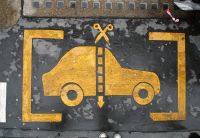
We propose banning private cars from Manhattan Island. Permitted motor vehicles would be busses, small taxis, vehicles for essential services (doctor, police, sanitation, vans, etc.), and the trucking used in light industry. Present congestion and parking are unworkable, and other proposed solutions are uneconomic, disruptive, unhealthy, nonurban, or impractical. It is hardly necessary to prove that the actual situation is intolerable. “Motor trucks average less than six miles per hour in traffic, as against eleven miles per hour for horse drawn vehicles in 1911.” “During the ban on nonessential vehicles during the heavy snowstorm of February 1961, air pollution dropped 66 percent.” (New York Times, March 13, 1961.) The ... (From : bopsecrets.org.)

From Selected Writings on Anarchism and Revolution, P.A. Kropotkin, edited and translated by Martin A. Miller. The letter appears in Anarchy Archives with the permission of the editor and translator. Dmitrov, 4 March, 1920 Esteemed Vladimir Ilich, Several employees of the postal-telegraph department have come to me with the request that I bring to your attention information about their truly desperate situation. As this problem concerns not only the commissariat of mail and telegraphs alone, but the general condition of everyday life in Russia, I hasten to fulfill their request. You know, of course, that to live in the Dmitrov district on the salary received by these employees is absolutely impossible. It is impossible even to buy a bushel ... (From : Anarchy Archives.)

The Unknown Revolution, 1917–1921. Book Two. Bolshevism and Anarchism | The Anarchist Library Voline The Unknown Revolution, 1917–1921. Book Two. Bolshevism and Anarchism Part I: Two Conceptions of the Revolution Chapter 1. Two Opposing Conceptions of Social Revolution Chapter 2. Causes and Consequences of the Bolshevik Conception Part II. About the October Revolution Chapter 1. Bolsheviks and Anarchists Before October Chapter 2. Anarchist Position on the October Revolution Chapter 3. Other Disagreements Chapter 4. Some Reflections Part III. After October Chapter 1. The Bolsheviks in Power; Differences Between the B...