 Browsing By Tag "ban"
Browsing By Tag "ban"
Pronunciation : Ban
Part of Speech : n.
Etymology : [AS. bann command, edict; akin to D. ban, Icel. bann, Dan. band, OHG. ban, G. bann, a public proclamation, as of interdiction or excommunication, Gr. to say, L. fari to speak, Skr. bhan to speak; cf. F. ban, LL. bannum, of G. origin. Abandon, Fame.]
Definition : 1. A public proclamation or edict; a public order or notice, mandatory or prohibitory; a summons by public proclamation.
2. (Feudal & Mil.)
Defn: A calling together of the king's (esp. the French king's) vassals for military service; also, the body of vassals thus assembled or summoned. In present usage, in France and Prussia, the most effective part of the population liable to military duty and not in the standing army.
3. pl.
Defn: Notice of a proposed marriage, proclaimed in church. See Banns (the common spelling in this sense).
4. An interdiction, prohibition, or proscription. "Under ban to touch." Milton.
5. A curse or anathema. "Hecate's ban." Shak.
6. A pecuniary mulct or penalty laid upon a delinquent for offending against a ban; as, a mulct paid to a bishop by one guilty of sacrilege or other crimes. Ban of the empire (German Hist.), an imperial interdict by which political rights and privileges, as those of a prince, city, or district, were taken away.
Source : Webster's Unabridged Dictionary, 1913
Pronunciation : Ban
Part of Speech : v.
Etymology : [OE. bannen, bannien, to summon, curse, AS. bannan to summon; akin to Dan. bande, forbande, to curse, Sw. banna to revile, bannas to curse. See Ban an edict, and cf. Banish.]
Definition : 1. To curse; to invoke evil upon. Sir W. Scott.
2. To forbid; to interdict. Byron.
t. [imp. & p. p. Banned (p. pr. & vb. n. Banning.]
Source : Webster's Unabridged Dictionary, 1913
Pronunciation : Ban
Part of Speech : v.
Definition : Defn: To curse; to swear. [Obs.] Spenser.
i.
Source : Webster's Unabridged Dictionary, 1913
Pronunciation : Ban
Part of Speech : n.
Etymology : [Serv. ban; cf. Russ. & Pol. pan a masterban.]
Definition : Defn: An ancient title of the warden of the eastern marches of Hungary; now, a title of the viceroy of Croatia and Slavonia.
Source : Webster's Unabridged Dictionary, 1913
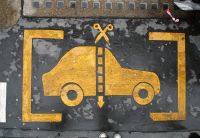
We propose banning private cars from Manhattan Island. Permitted motor vehicles would be busses, small taxis, vehicles for essential services (doctor, police, sanitation, vans, etc.), and the trucking used in light industry. Present congestion and parking are unworkable, and other proposed solutions are uneconomic, disruptive, unhealthy, nonurban, or impractical. It is hardly necessary to prove that the actual situation is intolerable. “Motor trucks average less than six miles per hour in traffic, as against eleven miles per hour for horse drawn vehicles in 1911.” “During the ban on nonessential vehicles during the heavy snowstorm of February 1961, air pollution dropped 66 percent.” (New York Times, March 13, 1961.) The ... (From : bopsecrets.org.)

Errico Malatesta (Pensiero e Volontà, n. 9, May 10, 1924) MEDICINE... AND ANARCHISM. — Under this title, in the editorial mail of our issue n. 5, we published a note by which we refused the invitation of some comrades to make propaganda in favor of certain methods of treatment conflicting with science and the commonly accepted medical practice. This fact upset comrade N. Cuneo from New York. Though acknowledging that Pensiero e Volontà is not the right place for medical discussions (in fact, he is not among those who urged us to that propaganda), in the April 15 issue of Libero Accordo he stands up for the “natural treatment”, i.e. a treatment without drugs, which is said to be making great progress, and to have... (From : Anarchy Archives.)